
Burst Through the Lens of Theranos Selling Stories and Buying Lies by Ilana Jael
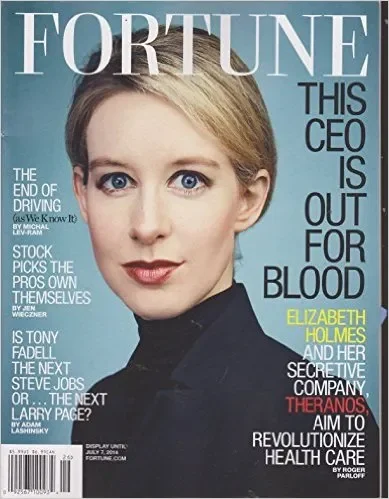
Founder of Theranos, Elizabeth Holmes on the cover of Fortune magazine.
At least as told by founder Elizabeth Holmes in a now notorious TED talk, the story of how her company Theranos came to be is an absolutely beautiful one.
“I believe that the individual is the answer to the challenges of healthcare,” she begins, and then draws us in with a vulnerable personal reflection about the early death of her uncle, something that fueled her enduring interest in the field.
Eventually, her vision of a world in which “nobody has to say goodbye too soon” took concrete shape into a desire to improve diagnostic accuracy with an innovation that she called the Edison. A device that would make blood testing more accurate, accessible, and endurable —and which could test for a myriad of diseases from only a single drop of blood.
There is something particularly captivating about the combination of her strong convictions, endearing awkwardness, and the almost alien demeanor that comes from her unusual looks and hypnotically deep voice. But the strength of her rhetoric itself is even more captivating, so much so that it obscured something else that seems only in hindsight like an obvious red flag.
Though she dazzles the crowd with a combination of moving anecdotes and sweeping expressions of idealism, she doesn’t say a single word about the science behind her breakthrough.
Effectively, there was no such science, because there was also no such breakthrough, a truth that fractures Holmes’ perfectly calibrated story into two competing narratives about who she was and why she did what she did.
As some have suggested, was she only a soulless, selfish conwoman, a kind of Bernie Madoff of blood testing? But some think she was such a good liar for an even stranger reason — to her, the stories were actually true. Or, at least, prospectively true, which might make Holmes less of a scam artist than someone who started out with noble intentions and then somehow got ahead of herself in a desperate attempt to realize them.
Figuring out what made Holmes tick explains some of my fascination with the Theranos story —for this psychology fanatic, she certainly makes a particularly compelling case study. On the other hand, at least individual pathology, however extreme, is something I can more or less wrap my head around. More, at least, than I can wrap my head around the massive systems failure that this pathology ultimately propelled.
Millions of dollars changed hands, and that’s not even going into the less tangible cost of how much time, effort and infrastructure went into this absurd deception. At its peak, Theranos boasted a $9 billion valuation and about 800 employees enlisted in the effort to perfect an “innovation” that was nearly as nonexistent the emperor’s new clothes.
The thing is, by itself, the fact that Holmes was able to secure high-level investors without having proof of much more than the concept for her Edison “device” when she first started Theranos wasn’t so out of the ordinary in the bizarre context of Silicon Valley startup culture.
She may have been a college dropout with a mere three semesters at Stanford to her name, but she was quickly able to build a board of high-profile investors with deep pockets by convincing them she had what it took to make her vision a reality. This gave her the funds to start putting together a team of more senior scientists. They, along with her big-name board, helped give the idea of Theranos more credibility, which snowballed into even more monetary support as subsequent investors were convinced by their cachet.
Ordinarily, though, funding would’ve started to dry up after a seed round or two failed to produce a viable product, and the story of Theranos would be just another tale of an ambitious effort that fizzled out.
But when early versions of the Edison failed to live up to her lofty ideals, Elizabeth started to exaggerate the efficacy of her prototype.

Portrait of Elizabeth Holmes holding a tiny vial of a blood sample.
Looking at these early forgeries, there’s evidence that she might have thought it was a temporary measure — after all, she was able to get some tests working sometimes on her Edison, so faking a demonstration or two for the purpose of raising money to perfect her machine could’ve struck her as justified.
But as Theranos’s coffers began to fill, her deceptions started becoming more sinister. For instance, she agreed to allow the Edison to be used in a study involving real patients long before the results of the test were reliable, which made several members of her research team uneasy.
But no one could voice these objections to Holmes or to her “enforcer” Sunny Balwani, Theranos’ chief operating officer, without immediate pushback.
Nor were they free to voice their concerns to outsiders or members of the media, having been forced to sign strict non-disclosure agreements upon accepting employment with the company.
As Holmes and Balwani’s hyperbolic claims about the Edison escalated into blatant lies, their willingness to use ruthless intimidation tactics to conceal these untruths escalated in turn. Theranos’s formidable legal team would bully potential whistleblowers into silence with dogged threats of prosecution, effectively creating a seemingly impenetrable fortress around their falsehoods and a culture of “secrecy and fear.”
Theranos’s lawyers were also hyper alert to any potential theft of the company’s intellectual property, which is particularly ironic given how worthless that intellectual property would ultimately turn out to be.
In one of the ugliest examples of this ruthlessness, her team relentlessly sued rival medical device company Fuisz Technologies over a patent for a device that would theoretically complement Theranos’s Edison. Theranos’s side won, and only after putting Richard Fuisz through a lengthy lawsuit that devastated him emotionally as well as financially, ultimately costing around 2 million dollars in legal fees.
That’s only the tip of the iceberg in terms of the horrifying consequences that Holmes’ deceptions had on Theranos’ employees, investors, and ultimately, patients.
In the case of Ian Gibbons, we have perhaps the most tragic example of these consequences. An accomplished biochemist, he was initially brought on to Theranos as their head scientist, but began to butt heads with Holmes over his high standards for their product and his intolerance for her misrepresentations of what their technology could do.
Because of this, he was eventually demoted to a menial role that allowed Theranos to continue to benefit from his qualifications but took away all of Gibbons’ say in the direction of their products.
This turned working for Theranos into a hellscape for Gibbons but, in his late 60s, he also feared he was too old to be a competitive candidate if he tried to leave the company for another position. Along with health challenges he was facing and the pressure to obscure the truth about Theranos’s products in an upcoming deposition, this situation fueled Gibbons’ descent into a deep depression, which in turn led him to take his own life in 2013.
In one interview, Gibbons’ wife mentions expecting some response to his death from Theranos, where Gibbons had been working since 2005. But they didn’t so much as send a card, only acknowledging what happened at all by requesting the return of his company laptop.
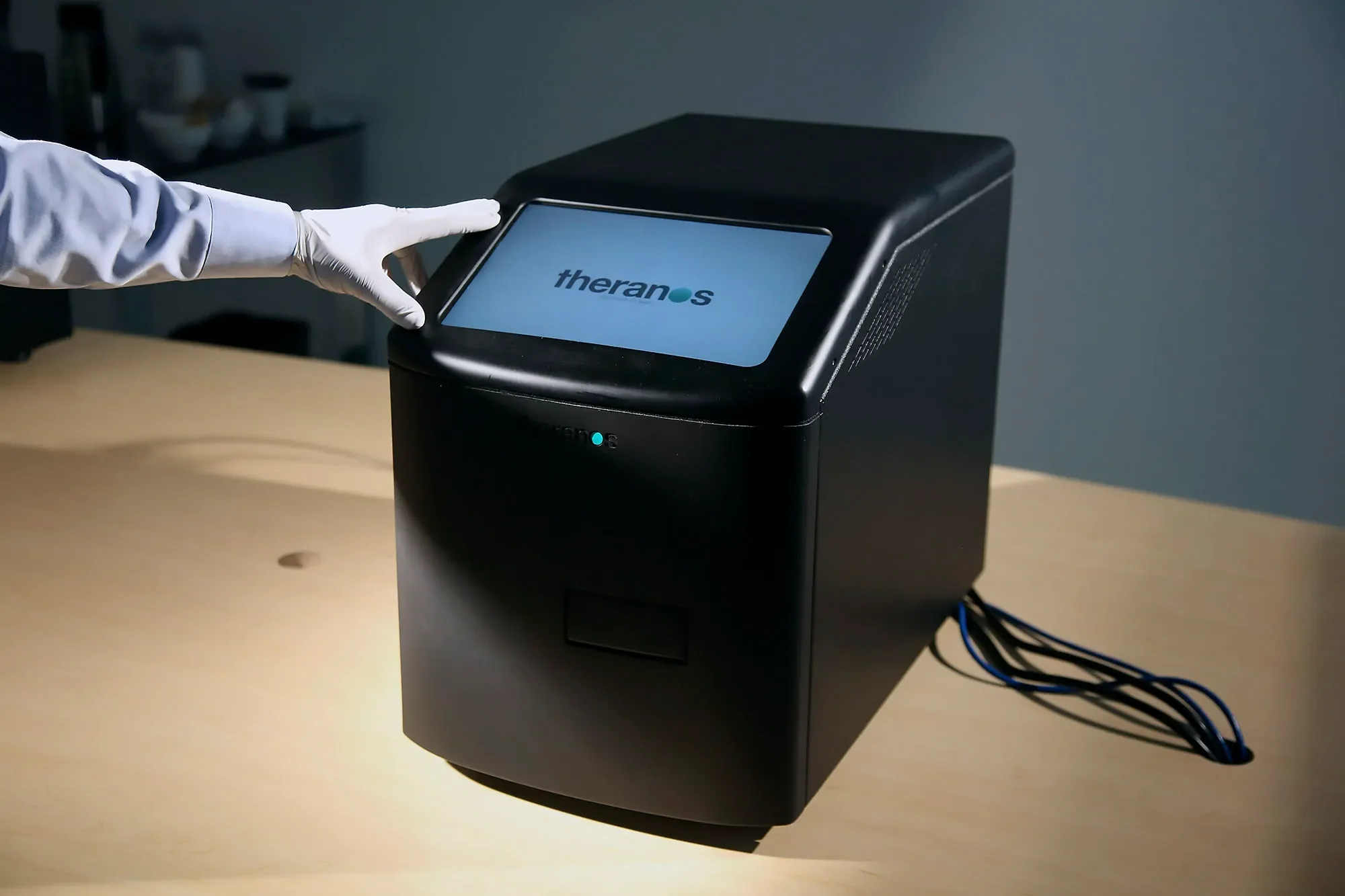
A blood-testing machine developed by Theranos.
Instead, Holmes kept pushing forward with a crusade that had now clearly crossed over from corporate misrepresentation into bald-faced fraud.
By then, ten years since Theranos’s founding, their product was still nowhere near ready for prime time — yet Holmes was able to secure the company their biggest contract yet, with the national drug store chain Walgreens. The vision was of a rollout of in-store Theranos’ clinics across the country, which started coming to fruition with over 40 pilot clinics by mid-2014.
Along the way, Holmes had also become a bit of a mainstream celebrity as well as a business-world wunderkind, appearing on television talk shows and the covers of magazines like Fortune.
But once real-world patients became part of the equation, the cracks quickly began to show. Since the Edison still wasn’t working consistently, patients were frequently asked to undergo traditional venous blood draws instead of the much-advertised fingerstick for some tests while Theranos ran others on machines manufactured by other testing companies using diluted fingerstick samples.
Both these practices and the few tests they did attempt to run on the Edison produced wildly unreliable results, necessitating unnecessary and expensive follow-up testing for many patients and, by distorting their understanding of their health status, altering countless others’ course of care.
For some, the false information from Theranos also had dire emotional consequences, such as in the case of a woman who was wrongly told she had suffered a miscarriage and another whose results incorrectly suggested a cancer recurrence.
After incidents like these, some healthcare providers became wary enough of Theranos to want to voice their suspicions. Using their firsthand accounts, as well as information provided by some courageous ex-employees who were willing to risk personal ruin by going on record, journalist John Carreyrou began to expose the large-scale scam that had become of Holmes’ beautiful vision. In an initial Wall Street Journal article, he made accusations damning enough to make others start seriously questioning Theranos’s practices. Ultimately, he would go on to publish several follow-up pieces as the company gradually dissolved in the face of increasing scrutiny, tracing the slow unraveling of Holmes’ labyrinthine web of lies.
In his book Bad Blood: Secrets and Lies in a Silicon Valley Startup, Carreyrou delves even deeper into the whole sordid story, painstakingly reconstructing the rise and fall of Theranos in great detail. His reporting is masterful throughout, but takes on a personal dimension that makes it even more riveting in the later chapters, which describe how Carreyrou’s commitment to blowing the whistle on Theranos turned him into their legal team’s chief target.
Bad Blood was one of my most useful sources when it came to crafting my own retelling of the Theranos story, though I also drew on a slew of others scattered across the internet. In a way, this blog post was only the surface incentive to spend more time trying, still, to wrap my mind around it all — taking in as much as I could of the disaster in much the way that one might crane their neck towards an auto crash to catch a glimpse of the wreck.
Other major works about Holmes and Theranos that informed this piece and that I’d recommend to anyone wanting greater insight include the documentary The Inventor: Out for Blood in Silicon Valley and the podcast series The Dropout, which was eventually adapted into a TV series of the same name that I eagerly devoured a few years ago when it premiered.
From what I can recall, this fictionalization takes a few narrative liberties but more or less sticks to the spirit of the truth about Theranos — which, ironically, is way more than I can give Elizabeth Holmes credit for.
You see, a little exaggeration for effect is quite fine when all you’re doing is trying to make good television… and a lot less so when you’re playing with people’s lives.
To circle back to the reason I’m even writing this, I’d also say that something of the spirit of the truth about Theranos makes its way into Burst.

Not only does Burst successfully dramatize many of the mechanisms behind Theranos’s failure, it makes those mechanisms more visible by transposing them into an imagined scenario, not to mention more dramatically compelling thanks to the play’s tight pressure-cooker structure.
But while there are distinct differences between the two, many of the strategies that main character Sarah Boyd uses to build and defend her company Tactix in Burst are taken straight from Elizabeth Holmes’ playbook, and a few distinct personality quirks and biographical details also overlap.
It’s a compliment to playwright Rachel Bublitz to say that Boyd emerges as a character whose psychology is as fascinatingly multifaceted as her counterpart’s, and whose journey proves every bit as riveting.
Now, the great thing about New City Players’ commitment to showcasing the work of playwrights working today is that I’m not just sending these compliments into the void like I would be if I were affording accolades to Shakespeare — I’m hoping to have a chance to deliver a few of them myself!
If all goes according to plan, I’m planning on closing out this blog series by interviewing Bublitz sometime in the next week or so, and am looking forward to the chance to learn even more about how and why Burst came to be.
Bublitz will also be coming to town for opening weekend of Burst and participating in a talkback after the matinee on July 12th, so that’s definitely the one you’ll want to catch if you think your viewing might inspire a few burning questions of your own.
Before she heads back to her hometown, she’ll also be hosting a special event at Island City Stage on Monday, July 13th entitled How to Build a Playwright, something that I’ve also marked on my calendar as a can’t-miss!
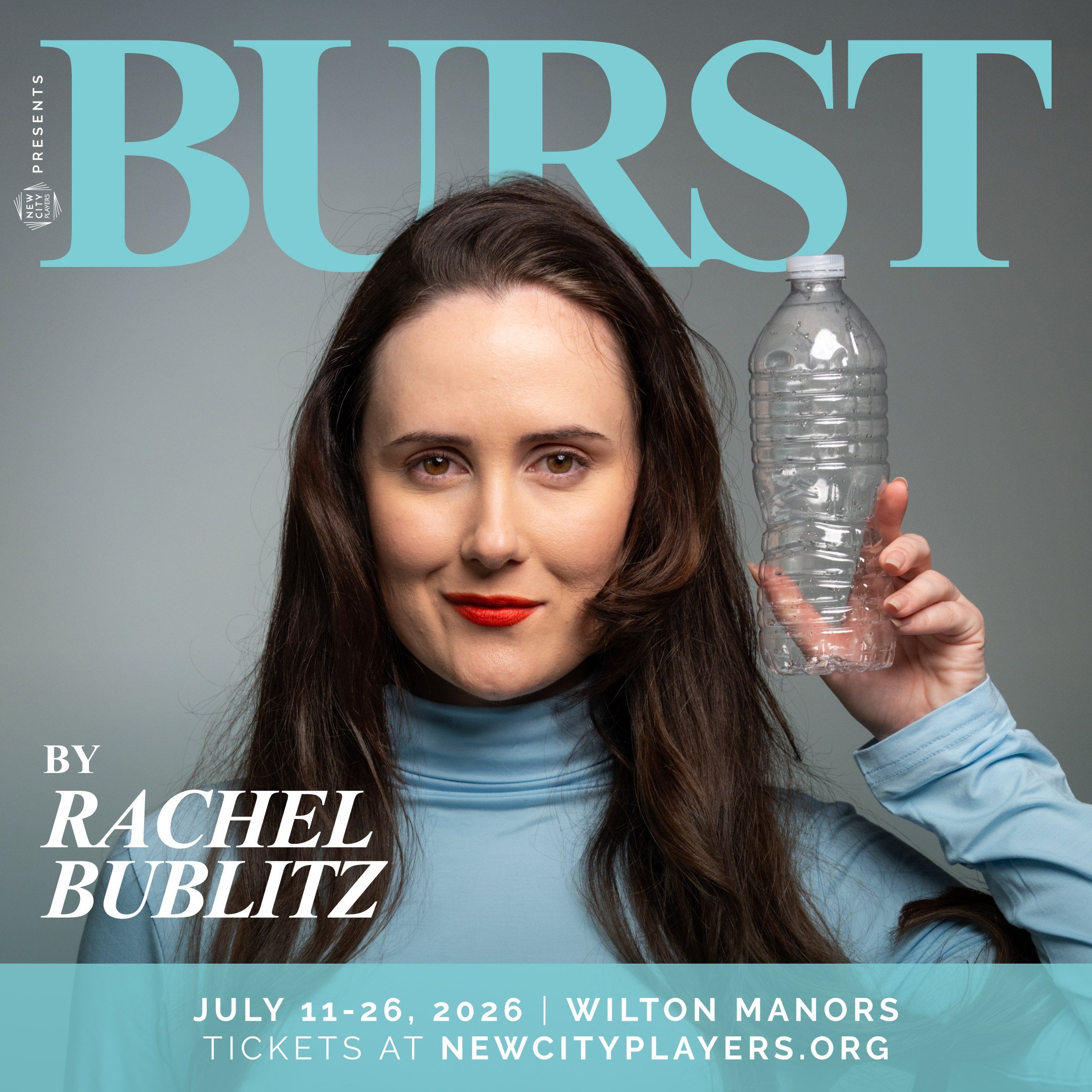
Burst
by Rachel Bublitz
Directed by Elizabeth Price
Southeastern Premiere
A sharp, dark comedy making its southeastern U.S. premiere, Burst unfolds over one late night in the CEO's office at Tactix — a tech company on a mission to eliminate plastic from the earth. When a tenacious journalist and a wavering CTO arrive uninvited and threaten to expose the gap between the company's promises and its reality, the play puts a spotlight on corporate responsibility, the seduction of big ideas, and the price of ambition.
WHEN
July 10 - Pay What You Wish Preview
July 11-26, 2026
PRICE
$40-45
Make sure to plan your visit after booking tickets!