
A Note from the Director of A Case for the Existence of God by Timothy Mark Davis
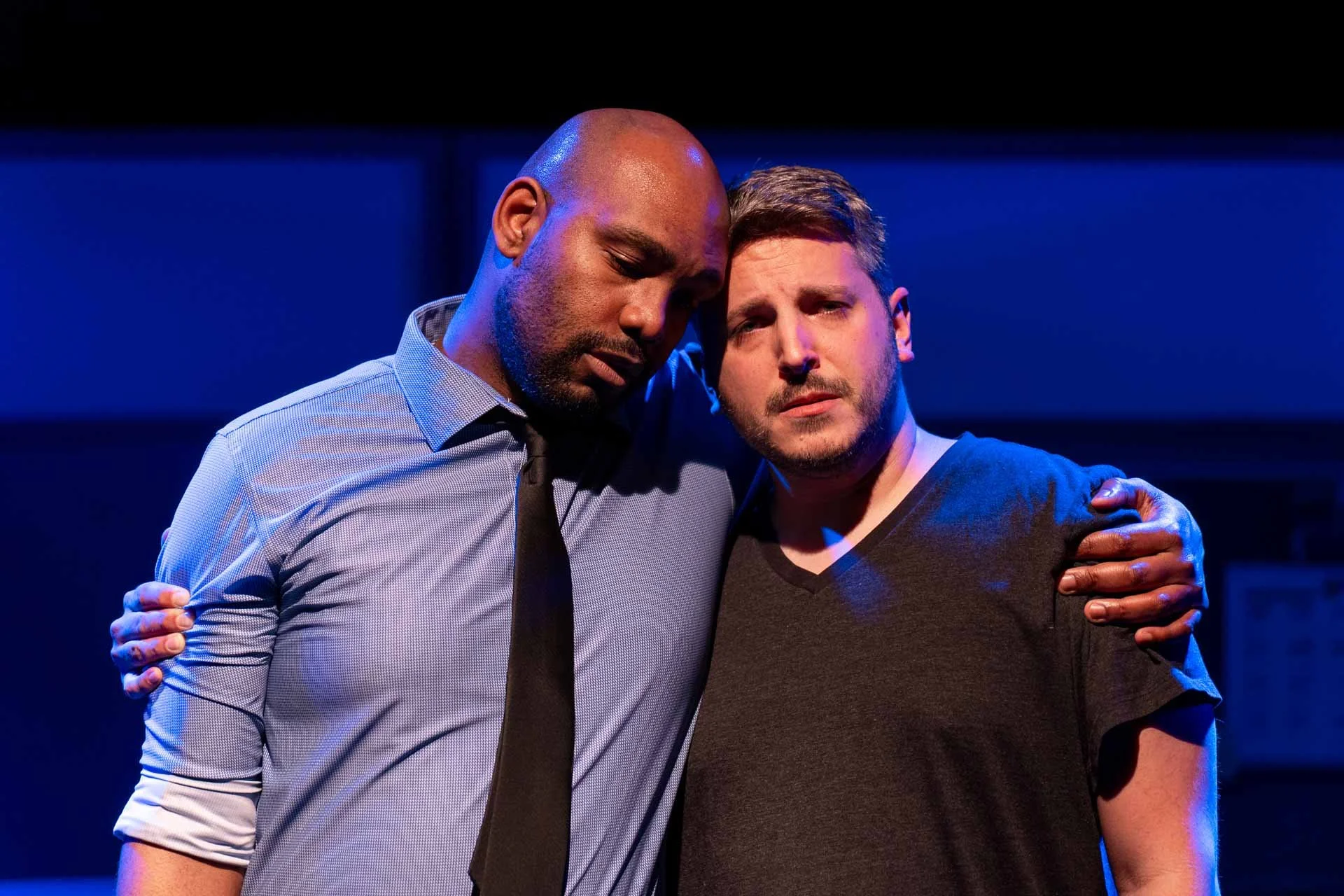
Randall Swinton (left) and Ryan Didato (right) in New City Players’ production of A Case for the Existence of God.
The subway rattled, screeched, and swayed. My eyes swelled with tears. I took a deep breath and closed the play. It was August 2024 and I’d just bought A Case for the Existence of God at The Drama Bookshop earlier that day. It only took a few subway trips to read, but it did that thing I am in constant pursuit of: it expanded my heart, it made my skin a little warm, it brought tears to my eyes, and it reminded me of our individual and collective need for healing.
In this play you will encounter two men who are stuck. Some of it is their fault. Some of it is not. If that isn’t universal, I don’t know what is. They are men in need of healing. They are men in need of help. Speaking as a man… it’s hard to ask for help. Centuries old scripts for masculinity passed down through genetics, unconscious behavior cues, and even formal “boys don’t do that” directions have created models for men that may have been good at keeping bears out of the cave, but aren’t as good at living a well-adjusted life in the 21st century. For a man, courage has long been seen as something physical, not something emotional. But we don’t live in a world where (for most of us) we’re defending the cave from bears. We live in a world where often the courageous thing to do is to be vulnerable, to be compassionate, to take a stand for our convictions, to be open to the idea that we may be wrong, to seek ways to make other people’s lives better, and to give more than we take. There is something grounded and unwavering and strong about this kind of courage–but it is not cold, distant, stoic, or lonely. In fact, it’s quite the opposite.

Ryan Didato (left) and Randall Swinton (right) in New City Players’ production of A Case for the Existence of God.
There is a reason that one of the 7 daily practices that lead to sustained happiness and good health sourced from an 85-year Harvard study was “stable, long-term friendships and loving relationships.” Every day I think about how important my relationships are to my health. And every day I feel the pull of not reaching out, of not imposing myself on others, of trying to do it myself. I listened to a podcast interview our playwright, Samuel D. Hunter, gave last year. He said that if there was one theme running through all of his work it was “the tragedy of isolation juxtaposed with the redeeming value of human connection.” Like it or not, we humans are meant to be together. This is hard. It’s messy. We hurt each other. We make mistakes. But the risk is worth it. Because we can forgive. We can take responsibility for our shortcomings. We can extend grace. We can set boundaries. We can be there for our friends in need. There is help for our healing. We can go from being stuck to being unstuck.
Each man’s life in this play is a different melody. You would think that if played together, they would clash, but instead they create something new, something powerful, and something beautiful. We are better together and Ryan and Keith remind us of that.
A step you could take? Impose yourself on your friends. Open up to them. Be courageous in your vulnerability. Especially for the men reading this. It’s not heroic to do it alone–it’s harmful.
So pause. Take a deep breath. And reach out. You may be surprised at the response.

A Case for the Existence of God
by Samuel D. Hunter
Directed by Timothy Mark Davis
A Florida Premiere
Two fathers. One cubicle. And a loan application that becomes a lifeline.
When Ryan walks into Keith's mortgage office, they're strangers united only by desperation—one fighting to keep his foster daughter, the other scrambling to secure his baby's future. But as the housing market collapses and their personal lives unravel, these two men from opposite worlds discover something unexpected: each other.
What happens when two people decide to stop being strangers? Funny, heartbreaking, and surprisingly hopeful, the play is about what happens when masculine isolation finally cracks—and grace floods in through the break.
WHEN
February 21-March 8, 2026
PRICE
$40-45
Make sure to plan your visit after booking tickets!